Within the complex landscape of global business, the ability to place qualified personnel to the right place at the optimal time is a crucial advantage. For multinational organizations, the L-1B visa serves as the expert's entry point-an essential tool for relocating staff with distinctive capabilities to the United States. This visa designation is specifically designed for personnel who demonstrate "specialized knowledge" that is essential to the company's operations, offerings, or services. However, the definition "specialized knowledge" stands as one of the most intricate and closely examined aspects in U.S. immigration law. This resource serves to demystify the L-1B visa, presenting a detailed framework for companies and employees aiming to employ this powerful opportunity. With the guidance of a seasoned L1 immigration attorney, the L-1B visa can open up new avenues for growth and innovation in the American market.
Key Takeaways
- L-1B visas is a temporary work permit for staff members with L-1B specialized knowledge that is critical to a company's interests.
- This serves as an essential component of the multinational company transfer program, enabling enterprises to harness their internal talent pool for operations in the United States.
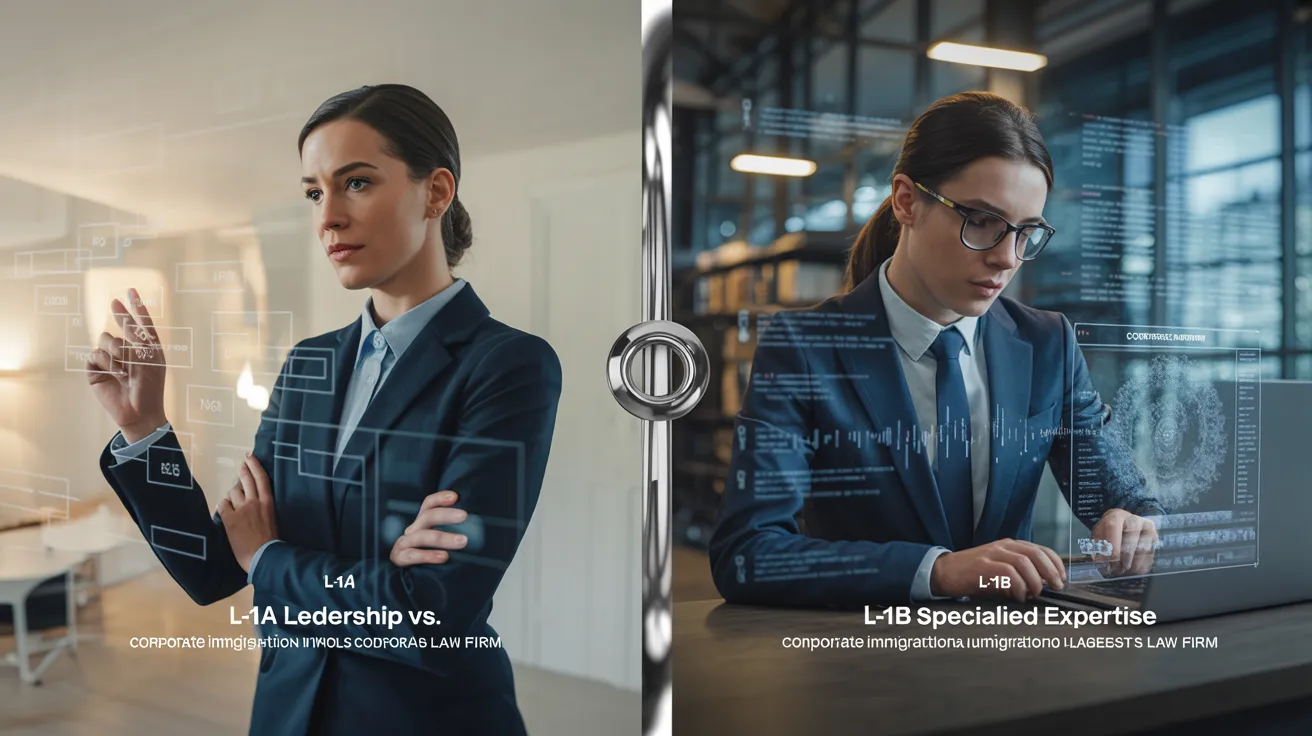
- Different from the executive transfer visa (L-1A), the L-1B highlights an employee's specialized knowledge and capabilities instead of their leadership roles.
- Demonstrating in-depth knowledge is a substantial evidentiary threshold, rendering the assistance of an L1 visa lawyer vital for building a strong case.
- A skilled L1 immigration attorney is your best resource while managing the complexities of the L-1B application, including addressing difficult Requests for Evidence (RFEs).
- Even though the L-1B comes with a five-year limit, it can serve as a route to a copyright, and an legal expert can guide you in planning for this future objective.
Global Business Dynamics: Understanding Multinational Company Transfers
The L-1 visa program serves as the foundation of global business, enabling the smooth movement of talent for a multinational company transfer. It permits organizations to move essential staff from their overseas locations to a parent, subsidiary, affiliate, or branch office in the United States. This intracompany transfer mechanism is vital for maintaining corporate culture, conveying institutional knowledge, and executing global business strategies. The L-1 visa comprises two unique categories: the L-1A for corporate leadership, and the L-1B for professionals with specialized skills. Although both categories fulfill the wider goal of promoting international business, they possess different requirements and strategic considerations. Grasping the nuances of this program is essential for any organization looking to establish its footprint in the U.S., and it's a procedure best managed with the counsel of an experienced immigration lawyer.
The Foundation of Your L-1B Case: Establishing L-1B Specialized Knowledge
The core of every L-1B visa petition rests on a single, crucial, and often complex concept: L-1B specialized knowledge. This definition is not straightforward, and how it's understood by U.S. Citizenship and Immigration Services (USCIS) has evolved over time. As defined by USCIS, specialized knowledge refers to expertise held by a person that is sophisticated and specific to the applying entity's operations, methodologies, technologies, processes, management practices, or other core aspects. This constitutes knowledge that is not generally present within the industry or that's difficult to convey to another individual without significant cost or business disruption. Establishing the existence of specialized knowledge needs to clear a high evidentiary threshold. It demands a thorough and persuasive showing that the employee's abilities and know-how are authentically special, proprietary, and vital to the company's U.S. operations. This is where the expertise of an L1 visa lawyer becomes indispensable in crafting a compelling and thorough case.
The Executive's Path: A Guide to L-1A Transfer Visas
To thoroughly grasp the distinct characteristics of the L-1B visa, it is helpful to distinguish it with its executive counterpart, the L-1A visa. The L-1A is an executive transfer visa created for senior leadership personnel who will be directing the administration of the organization or a key division. The focus of the L-1A is on the individual's senior-level managerial or executive duties and their power to determine outcomes and direct the work of others. In contrast, the L-1B centers on the specialized nature of the individual's knowledge, regardless of their position in the corporate hierarchy. While an L-1A beneficiary directs the team, the L-1B beneficiary is usually the essential technical expert or specialist on that team. Recognizing this difference is essential for choosing the correct visa category and for building a successful petition, as the documentation needs for each are distinctly different.
Creating an Ironclad Case: How an L1 Visa Lawyer Proves Professional Expertise
Proving the existence of L-1B specialized knowledge requires both creativity and precision, and it is a task best entrusted to a qualified L1 visa lawyer. A successful petition is an unshakable case founded upon thorough detailed evidence and persuasive legal arguments. An knowledgeable lawyer will work closely with the company and the employee to pinpoint and explain the specialized skills that sets the employee apart. This involves a thorough analysis of the organization's unique methods, systems, and operational procedures. The lawyer will then gather a diverse collection of evidence to strengthen the case, which may include proprietary documents, training manuals, project reports, and management endorsements. The objective is to paint a comprehensive and persuasive argument for the USCIS adjudicator, demonstrating that the employee's knowledge is beyond useful, but fundamentally important to the U.S. operation's growth. This meticulous case-building is the signature of a top-tier L1 immigration service.
Navigating Success: A Step-by-Step L-1B Application Guide
Managing the L-1B application process is comparable to following a strategic plan for success. With the assistance of an L1 immigration attorney, the process can be separated into a series of manageable steps. It initiates with a detailed eligibility assessment of both the company and the employee. This is succeeded by the methodical preparation of the petition, which includes the collection of all necessary documentation and the creation of the legal arguments. Once the petition is submitted with USCIS, there is a period of adjudication, during which the government reviews the case. If USCIS demands additional information, they will issue a Request for Evidence (RFE), which must be answered in a timely and comprehensive manner. Upon authorization of the petition, the employee can then request their L-1B visa at a U.S. consulate or embassy abroad. The last phase is the visa interview, after which the employee can enter the U.S. and commence their assignment.
Navigating Immigration Complexity: How an L1 Attorney Serves as Your Guide
The U.S. immigration system represents a complicated and demanding administrative process. An L1 immigration attorney serves as your representative, navigator, and defender throughout this process. Their role extends beyond document submission; they offer strategic direction and to foresee and resolve potential issues. Throughout the entire process, from first evaluation to visa approval, a seasoned legal professional will guide you, ensuring that your case is presented in the strongest possible light. They will guide you through the intricate regulations, prepare for the scrutiny of USCIS adjudicators, and address any complications that emerge. Given that any mistake could cause significant delays or application denial, the benefits of experienced legal counsel are invaluable.
Navigating Challenges: RFEs and Denials
When you receive a Request for Evidence (RFE) or a denial on an L-1B petition is often a significant setback, but it's not necessarily the end of the journey. This represents a critical moment where the knowledge of an L1 immigration attorney is most crucial. An seasoned attorney will meticulously analyze the RFE or denial notice to identify the government's position and to determine the particular areas of concern. They will then collaborate with you to develop a strategy for addressing the RFE or for challenging or resubmitting the case in the case of a denial. A well-crafted RFE response or appeal needs not just additional evidence, but also a convincing legal argument that specifically targets the government's concerns. With the appropriate legal strategy, it is often possible to address these obstacles and secure a favorable outcome.
The Blanket L-1: A Streamlined Option for Eligible Companies
For large, established multinational corporations, the Blanket L-1 program provides a straightforward and productive approach for transferring employees to the United States. Upon securing an approved Blanket L petition, the company can move employees, including those with L-1B specialized knowledge, without having to file an individual petition with USCIS for each employee. Alternatively, the employee can request their L-1B visa straight at a U.S. consulate or embassy abroad. This substantially decreases processing times and administrative burdens. To be eligible for the Blanket L program, a company must satisfy certain size and activity level requirements. An experienced L1 visa lawyer can counsel a company on whether they are eligible for this program and can assist with the preparation and filing of the Blanket L petition.
Navigating Life in America: L-1B Status Privileges and Limitations
Residing in the United States on an L-1B visa includes a specific set of rights and limitations. The fundamental right is the ability to live and work in the U.S. for the petitioning employer. L-1B visa holders are also able to bring their qualifying dependents with them on L-2 dependent visas. A notable benefit is that L-2 spouses are qualified to apply for work authorization, enabling them to work for any employer in the U.S. However, there are also limitations. The L-1B visa has a maximum of five years, and once this limit is reached, the individual must typically depart the U.S. for at least one year before they can be eligible for a new L or H visa. It is also crucial to note that the L-1B is a non-immigrant visa, and holders must maintain an intent to depart the U.S. upon the termination of their status.
From Specialist to Resident: Pathways to a copyright for L-1B Holders
Even though the L-1B visa is considered a temporary, non-immigrant visa, it can function as a important stepping stone from specialist to resident. Many L-1B holders, the main aim is to acquire permanent residency (a copyright) in the United States. Even though the L-1B does not have a direct path to a copyright comparable to the executive transfer visa (L-1A) does, there are still feasible pathways. An L-1B holder could possibly qualify for a copyright through the PERM labor certification process, where their employer supports them for permanent residency. In another scenario, if the L-1B holder advances to a managerial or executive position, they may become eligible to file for a copyright under the EB-1C category. An experienced L1 immigration attorney can provide invaluable strategic guidance on the most appropriate pathway to a copyright based on the individual's unique circumstances and career trajectory.
Questions and Answers
How does immigration law define L-1B specialized knowledge?
The legal definition of website L-1B specialized knowledge is complex and subject to interpretation by USCIS. This category refers to knowledge that is specialized and unique to the petitioning organization's products, services, research, equipment, techniques, management, or other interests. It must be knowledge that is not commonly held within the industry and that cannot be easily transferred to another individual without substantial cost or difficulty. Demonstrating that a worker's expertise satisfies these requirements calls for thorough documentation and a detailed explanation of why their skills are specialized and crucial to the company. An L1 visa lawyer is crucial for building a case that effectively demonstrates this.
What are the key differences between L-1B and H-1B visas?
The L-1B and H-1B visas are both non-immigrant work permits, but they have several key differences. The L-1B is an intracompany transfer visa that requires the employee to have been employed with a related foreign entity for one year or more before coming to the U.S. The H-1B is designed for individuals in specialty occupations and has no requirement for prior employment with a related foreign company. The H-1B is subject to an annual cap, making it a lottery-based system, whereas the L-1B has no annual cap. The L-1B necessitates company-specific specialized knowledge, whereas the H-1B demands a bachelor's degree or its equivalent in a specific field.
Is it possible to switch employers with an L-1B visa?
The L-1B visa is tied to a specific employer. You can only work legally for the sponsoring employer of your L-1B visa. Should you want to switch companies, your prospective employer must submit a new visa petition for you, like an H-1B or other suitable visa classification. You cannot simply transfer your L-1B status to a new, unrelated company. This represents a significant distinction from other visa categories and is crucial for L-1B visa holders to understand.
What are the consequences of an L-1B petition denial?
In the event your L-1B petition receives a denial, your L1 immigration attorney will analyze in detail the denial notice to determine the reasons for the decision. According to the circumstances, you may have several options. You can potentially file a motion to reopen or reconsider the case if you conclude there was a legal error in the decision. Alternatively, you could file an appeal with the Administrative Appeals Office (AAO). In certain situations, the optimal approach could be to refile the petition with additional evidence that addresses the problems raised in the denial. An experienced attorney will assist you choose the best course of action.
Is there a path from an L-1B copyright permanent residency?
It's true, it is possible to secure a copyright while on an L-1B visa, although there is no direct path. The most common route is through employer sponsorship via the PERM labor certification process. This necessitates the employer showing that there are no qualified U.S. workers suitable for the position. Another potential pathway is when the L-1B employee is promoted to a managerial or executive position within the company. In this case, they may become eligible to file for a copyright under the EB-1C category for multinational managers and executives, which doesn't need a labor certification. A experienced L1 visa lawyer can provide direction on the optimal long-term immigration approach.